Run the plant as
one connected flow.
Manufacturers lose margin in the gaps between systems — a plan that doesn't see the shop floor, a quality hold that stock doesn't know about, a maintenance backlog that no one prices against output. Compreo runs process manufacturing, discrete manufacturing and plant maintenance on a single low-code platform, so Plan-to-Produce, Procure-to-Pay, Plan-to-Maintain and Record-to-Report behave as connected processes rather than four disconnected modules. Every PR, GRN, batch and work order writes to one record the whole plant reads.
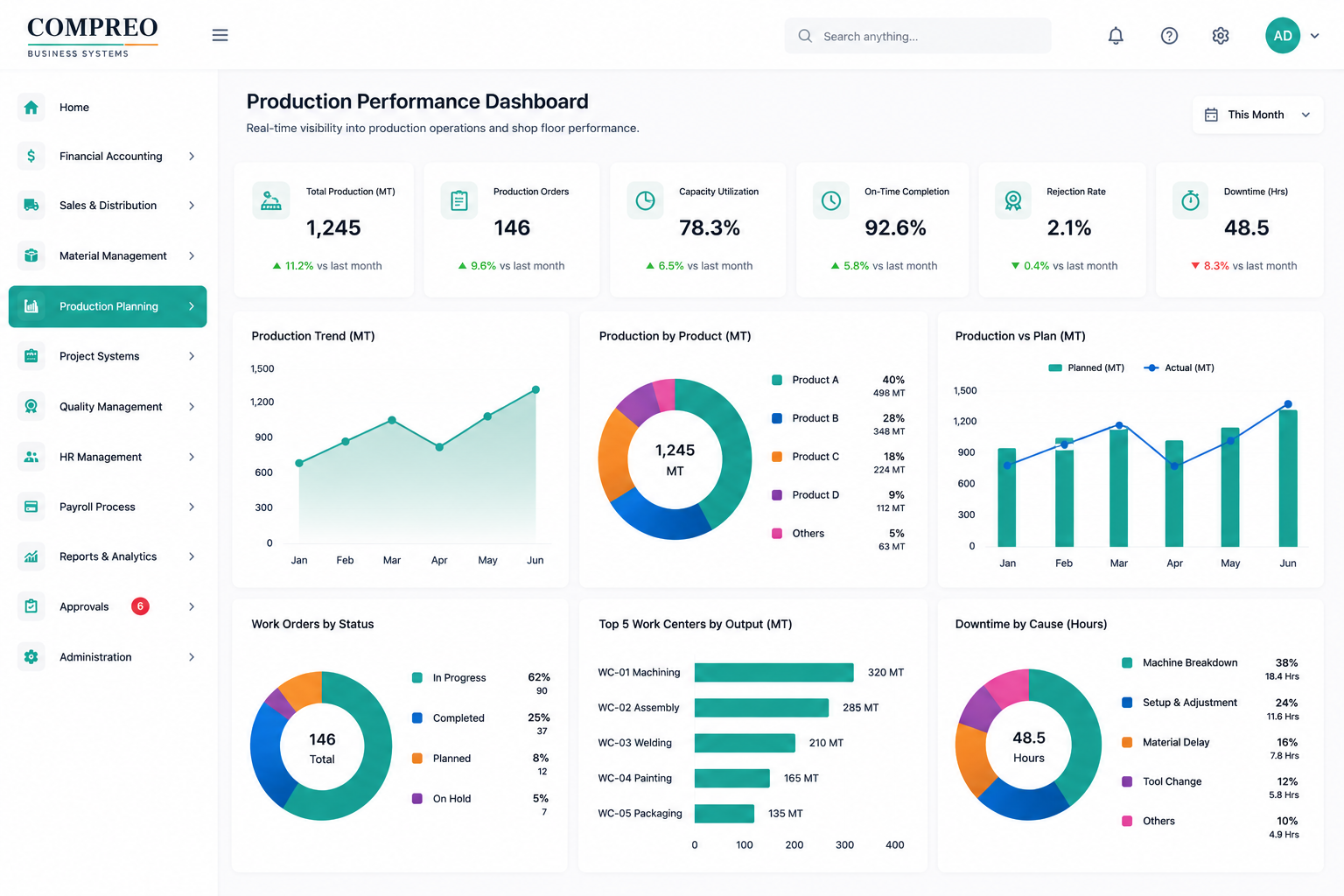
The processes that run your plant.
Four core processes carry most of a manufacturer's working day. On Compreo they share one master data layer — the same material, the same UOM, the same vendor — so a decision taken in planning is already visible to purchase, quality, stores and finance.
Plan-to-Produce
Turn demand and forecast into MPS/MRP, release work orders against live BOM and routing, and execute on the shop floor with real-time consumption and yield.
Procure-to-Pay
Convert net requirements into PR, RFQ and PO, receive against quality, and close the loop with a 3-way match before payment.
Plan-to-Maintain
Run preventive and breakdown maintenance against asset and spares masters, so a machine stoppage raises a work order and reserves the right part.
Record-to-Report
Cost every batch and work order as it runs, post inventory and consumption automatically, and close the period without re-keying.
Built for how plants
actually run.
Generic ERP treats manufacturing as a posting engine. Compreo models the production reality — multi-level structures, in-line quality, and the maintenance that keeps the line moving.
Process plants lean on batch, expiry and in-process QM; discrete plants lean on multi-level BOM, routing and serial traceability. Both run on the same platform — you configure the emphasis, not a separate system.
See the Production Planning module →- BOM & routing — Multi-level bills of material and operation routing, with alternates, scrap factors and UOM conversions, kept in step with engineering changes.
- MRP / MPS — Net requirements that read live stock, open POs and work orders, then raise the PR or production order the plant actually needs — not a static reorder list.
- Shop-floor execution — Work-order release, operation booking, material issue and real-time consumption and yield, so plan and actual never drift apart.
- QM gates — in-process & GRN — Quality holds at goods receipt and between operations; stock stays quarantined until inspection clears it, and a failed lot never reaches the line.
- Batch / lot & traceability — Full genealogy from raw lot to finished batch, for recall, expiry and customer audit across both process and discrete lines.
- Plant maintenance & spares — Preventive schedules, breakdown work orders and a spares store that reserves and consumes against the same inventory the plant runs on.
Plan-to-Produce, end to end.
This is the flow that defines a plant. Demand becomes a schedule, the schedule becomes work, work consumes material under quality control, and finished stock posts with its full cost — without a single re-key between steps.
Demand & forecast
Sales orders and forecast roll into a master schedule the plant can commit to.
MPS / MRP
The plan explodes against BOM and routing, nets off live stock and open orders, and proposes what to make and buy.
Procure shortfalls
Net requirements raise PR → RFQ → PO, received under GRN and inspection.
Work-order release
Production orders release against confirmed material and capacity, with operations sequenced on the routing.
Material issue
Components issue from stores against the order, reserving batch and lot where genealogy is required.
Shop-floor execution
Operators book operations and report real consumption, yield and rejection as the order runs.
In-process QM
Quality gates clear or hold the order between operations; nothing moves forward on an open defect.
Receipt to stock
Finished goods post to inventory under a final GRN and quality release, carrying their batch and cost.
Cost & settle
Work-order variances settle to cost of production and feed Record-to-Report at period close.
What changes on the floor.
See Plan-to-Produce running on your data.
Bring a real BOM, a real routing and a week of demand. We'll walk the full flow — plan, procure, produce, inspect and cost — on your own numbers, across process, discrete and plant maintenance.