From demand signal
to finished goods.
Plan-to-Produce is the chain that turns a demand number into a planned, made and accepted product. It runs across planning, stores, the shop floor, quality and finance — the people who decide what to build, the people who release material, the operators who run the line, and the inspectors who pass or hold it. Most ERPs run these as separate islands, so the plan, the material and the line drift apart. Compreo runs the whole sequence as one flow, with every order, issue and inspection joined to the next.
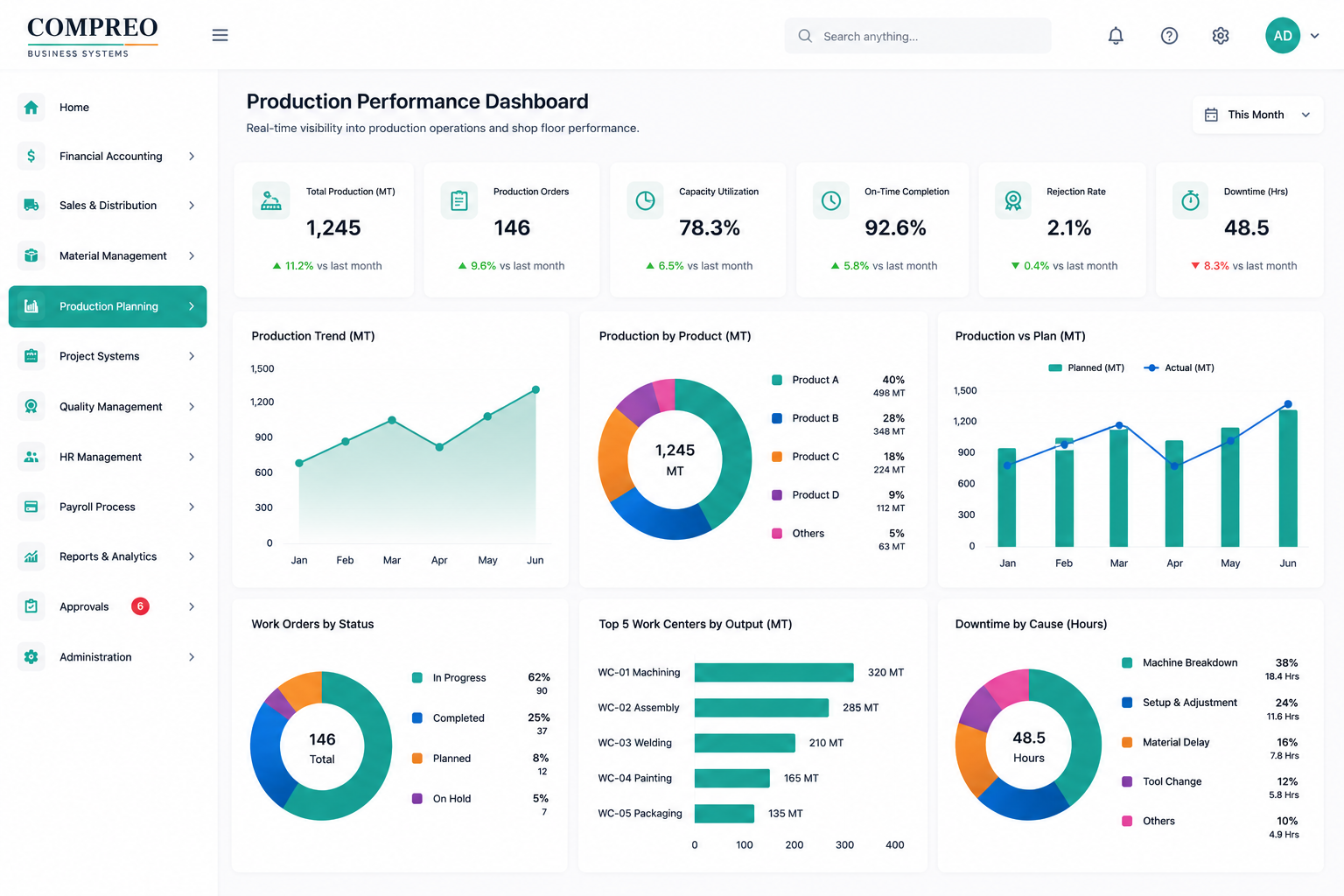
The stages of Plan-to-Produce
Eight stages carry a product from a forecast to a stocked finished good. Each one hands a verified result to the next, so nothing is re-keyed and nothing is assumed.
Demand
Consolidate forecast, sales orders and stock-replenishment into a single demand picture by item and period.
MPS
Set the master production schedule: what to build, in what quantity, by when, at which plant.
MRP
Explode the schedule against the BOM and on-hand stock to net out requirements and raise planned orders and PRs.
Production Order
Firm a planned order into a released production order with routing, UOM, quantities and dates.
Material Issue
Issue components from stores against the order, backflushing or picking by reservation.
Shop-floor Execution
Confirm operations, work-centres, run-time and yield as the order moves down the line.
In-process QC
Inspect at the gate; pass, hold or rework before the lot is allowed forward.
Receipt to Stock
Post the accepted quantity to finished-goods inventory and settle the order to FI.
What's hard about this process
The chain breaks at the joins, where one team's record stops being true for the next.
MRP drifts from reality
The run is only as good as the master data behind it. When BOMs, lead times or on-hand balances are stale, MRP plans against a factory that no longer exists — and planners spend their day correcting the planner.
Shortages surface late
A missing component is often found at issue, when the operator is already at the machine. By then the PR is too late to help, and the order waits on the line instead of on a planner's desk.
Quality is checked after the fact
When inspection sits outside the order, a bad lot can be issued, run and even received before anyone holds it. The defect is caught downstream, where it costs the most to unwind.
WIP is invisible
Between issue and receipt, value disappears into the floor. Finance sees an opening balance and a closing balance, but no live view of what is on which work-centre, so variances are explained weeks later, not managed in the moment.
How Compreo handles it
Each stage writes to the same order, so the plan, the material and the line never argue.
One demand picture, one schedule
Forecast, sales orders and replenishment feed a single MPS, so MRP plans against numbers everyone agrees on.
MRP that nets against live stock
Requirements explode through the current BOM and real on-hand balances, raising planned orders and PRs early — shortages appear on the planner's screen, not at the machine.
The order carries everything
Routing, components, UOM, work-centres and dates live on the production order, so issue, confirmation and inspection all reference the same document.
Issue tied to reservation
Material moves out of stores against the order's reservation, with backflush where it fits, so consumption and the plan stay matched.
Quality inside the flow
In-process QC is a gate on the order. A held lot cannot be received, so a defect stops at the work-centre instead of travelling to finished goods.
Live WIP and clean settlement
Confirmations post value as work happens, and receipt to stock settles the order to FI — so cost and variance are visible while the order is still open.
How this runs by industry
The spine is the same; the shape of an order and the placement of the quality gate change by vertical.
Production runs in batches against a recipe, and In-process QC must clear before stock is available. The accepted batch is received with its quality result attached, so a held lot is never sellable. Yield, by-products and shelf-life ride on the order, and UOM conversion between input and output is handled on receipt.
Work is driven by routing and work-centres, with operations confirmed in sequence as the order moves down the line. Components issue against the order, and in-process checks sit at named operations — so the line, the BOM and the inspection plan stay aligned through every confirmation.
Production is rarely used here; the make happens on site, not on a line. Material and progress are governed through project procurement and the BOQ/WBS rather than production orders, so this flow is the exception, not the rule, on a construction job.
Which modules participate
Plan-to-Produce is run by four modules working on one shared order, each owning its part of the chain.
PP — Production Planning
Demand, MPS, MRP, the production order, routing and confirmations.
MM — Materials Management
Stock netting, PRs, component material issue and receipt to stock.
QM — Quality Management
The in-process QC gate, hold/release and the quality result on the order.
What changes when the chain holds.
One order from plan through receipt, with quality and cost visible the whole way down the line.
See Plan-to-Produce running on your data.
Bring one product line and watch demand turn into a planned, made and accepted finished good — in a single connected flow.