Engineer, procure,
construct — one platform.
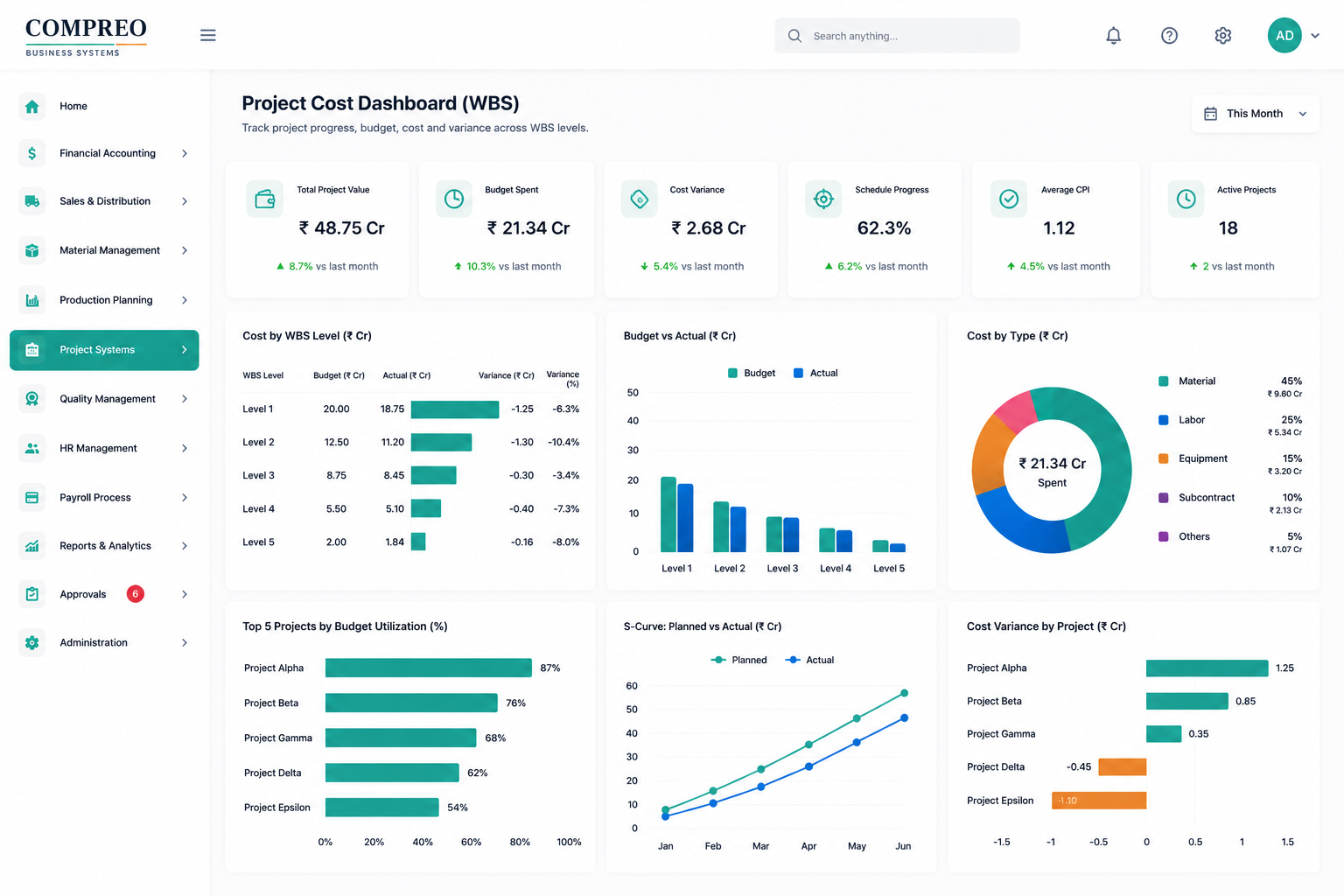
An EPC contract is won on the estimate and lost in the gap between teams. Engineering issues a revision, procurement is still buying to the old quantities, the site has already received material against the wrong cost head, and finance cannot bill the client because the milestone evidence sits in three systems. Compreo runs the whole contract as a single flow — from the WBS and BOQ through procurement, subcontracts and site receipt to milestone billing and cost-to-complete — so the project plan, the purchase order and the invoice are always the same version of the truth.
The processes an EPC contract
actually runs on.
EPC is not one process — it is three contractual obligations running at once, against a plan that keeps moving. Compreo gives each its own flow, but binds all three to the same WBS, so a change in engineering ripples into procurement and billing without a single re-key.
Project-to-Cash
The signature flow. From WBS and BOQ baseline through procurement, subcontracts and progress to milestone billing and revenue recognition — the contract managed end to end, not in fragments.
Procure-to-Pay, tied to the project
Every PR, RFQ and PO raised against a BOQ line and a WBS element — procurement that buys to the project plan, not to a stock minimum that no EPC job has.
Acquire-to-Retire
Construction equipment, formwork and owned plant tracked from acquisition through deployment, depreciation and disposal — utilisation and cost charged back to the job that used it.
Built around the WBS,
not bent into shape.
Generic ERPs assume a warehouse and a price list. An EPC job has neither — it has a work breakdown structure, a bill of quantities the client signed, and a clock running on every milestone. Compreo ships with the controls EPC teams expect on day one.
See Project-to-Cash →- WBS — Plan, budget and track every cost against a structured work breakdown; activities, packages and cost heads roll up to the project P&L automatically.
- Project procurement against BOQ — Requisitions draw from the BOQ, not from stock; quantities, UOM and rates carry through to RFQ and PO so what you buy reconciles to what you estimated.
- Subcontracts — Award and run labour and works packages with their own scope, rate schedule, running account bills and retention — measured at site, certified, and posted against the WBS.
- Milestone & progress billing — Raise client invoices on certified milestones or measured progress, with retention, advance recovery and tax handled in line.
- Cost-to-complete — Committed cost, incurred cost and forecast in one view, so the project head sees margin erosion while there is still time to act.
- Equipment & asset tracking — Owned and hired plant tracked by location and job, with depreciation and hire cost charged to the WBS element that consumed it.
Project-to-Cash, from estimate
to certified bill.
This is the flow EPC contractors live in. One spine carries the contract from the WBS baseline to the client invoice — engineering, procurement, site and finance all writing to the same project, the same version, at the same time.
WBS & BOQ Baseline
Lock the work breakdown, budget and bill of quantities the contract was won on.
Requisition
Site or engineering raises a need against a BOQ line and a WBS element.
RFQ & Award
Float enquiries to approved vendors, compare landed cost, award against the project budget.
Purchase Order
Issue the PO tied to the WBS; commitment posts to cost-to-complete immediately.
Subcontract
Award works packages with scope, rate schedule and retention terms.
Site GRN
Receive and inspect at site, UOM-correct, charged to the right cost head.
Progress Measurement
Capture measured work and milestone completion for billing and certification.
Milestone Billing
Raise the client invoice on certified progress, with retention and advance recovery applied.
Cost-to-Complete
Committed plus incurred versus forecast — margin visible in real time.
What changes when the contract
runs as one flow.
“We stopped reconciling between the estimate, the purchase order and the bill. Engineering, the site and finance finally see the same project — at the same time.”
Project Director · Mid-market EPC contractor
The modules working
underneath the contract.
Nobody runs an EPC job by opening a module — they run a project to cash. Underneath, these modules collaborate as the participants in that flow, each linking to its own page.
See your EPC contract running in Compreo.
Bring the flow that hurts most — off-plan procurement, milestone billing, or cost-to-complete that arrives too late — and we will show you that exact process on a project shaped like yours, with your WBS and your terminology.