From WBS and BOQ to recognised revenue
Project-to-Cash is the cycle a delivery business runs from the moment an opportunity is won to the moment the project is closed and its revenue recognised. It crosses the project office, procurement, the site or shop floor, quality, and finance — and on most ERPs each of those teams works from its own copy of the truth, so the WBS, the BOQ, the purchase orders, the progress claims, and the ledger never quite agree. Compreo runs the whole cycle as one flow, with a single project structure that carries cost and revenue from budget through billing to closeout.
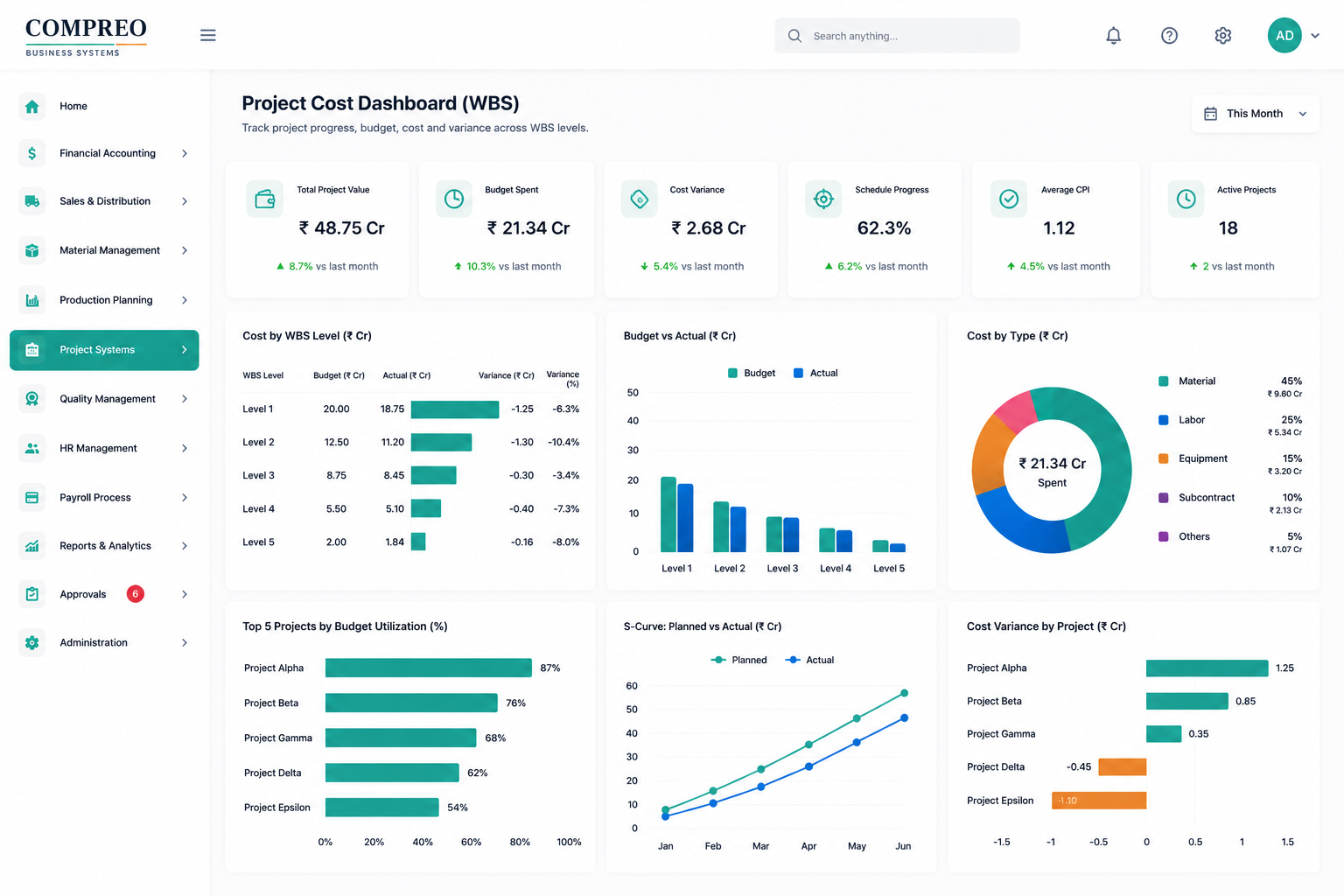
The stages, end to end.
One project structure carries every figure from the won bid to the closed-out WBS — no copy of the truth left behind in a spreadsheet.
Opportunity
Capture the won bid with its scope, value, and delivery terms, and convert it into a project shell.
WBS / BOQ
Break the project into a work-breakdown structure and price it against the bill of quantities so every line has a cost and a billing basis.
Budget
Lock the approved cost and revenue budget to the WBS, by element and by period, as the baseline everything is measured against.
Project Procurement
Raise PR and RFQ against WBS elements, award, and commit spend that is tied to the budget line it draws down.
Execution
Receive against the project with GRN, book labour and subcontract progress, and accrue cost where work is done.
Progress / Milestone Billing
Raise progress or milestone claims on measured work, apply retention, and invoice the customer against the BOQ.
Revenue Recognition
Recognise revenue on percentage-of-completion or milestone basis, matched to cost incurred and the budget baseline.
Closeout
Settle the project, release retention, reconcile final cost-to-complete to actuals, and close the WBS.
Where Project-to-Cash usually breaks.
When the project office, procurement, the site, and finance each keep their own version of the numbers, the gaps surface late — and always in the wrong direction.
Procurement detached from the WBS
Purchase orders get raised against a cost centre or a general material code, not against the WBS element they belong to. The project office sees a budget; procurement sees a spend; and no one can say which WBS line the commitment actually consumed.
Cost-to-complete is a guess
Committed POs, received GRN, booked labour, and pending claims live in different systems. By the time finance assembles a view, the cost-to-complete is weeks old and the project is already over or under without anyone knowing.
Billing lags physical progress
Work is measured at site or on the floor, but the progress claim is built later from a spreadsheet against the BOQ. The lag means revenue is recognised late, cash is claimed late, and disputes over measured quantity surface after the bill is out.
Retention goes untracked
Retention is deducted on every claim and is meant to be released at milestones or closeout. When it is tracked outside the ledger, amounts get lost, releases get missed, and the project closes with money still owed in both directions.
One project structure, end to end.
Budget, commitment, received cost, progress, billing, and revenue all post against the same project elements — so every figure rolls up to one structure.
A single WBS carries everything
The WBS and BOQ are the spine. Budget, procurement commitment, received cost, progress, billing, and revenue all post against the same project elements, so every figure rolls up to one structure.
Procurement draws down the budget line
A PR raised in execution carries its WBS element. The RFQ, award, and PO inherit it, so the commitment lands on the exact budget line it consumes — and an over-commitment is visible before the PO is released, not after.
Cost-to-complete is live
Commitments, GRN, labour, subcontract progress, and pending claims sit on one project ledger. Cost-to-complete and earned value update as documents post — not at month-end.
Billing follows measured progress
Progress and milestone claims are raised on measured quantity against the BOQ, with retention applied automatically and tracked in the ledger. Revenue recognition reads the same progress, so the claim, the invoice, and the recognised revenue agree by construction.
Closeout reconciles, it doesn't reconstruct
At closeout the project settles to actuals, retention is released against what was withheld, and the WBS closes with cost and revenue already matched — no end-of-job rebuild.
How it shapes to your delivery model.
The cycle is the same; the document discipline and the billing basis change with the kind of work you deliver.
Engineering, procurement, and construction work is billed on milestones tied to the WBS. Compreo links each milestone to its budget element and its claim, so engineering deliverables, procured equipment, and site progress all recognise revenue on the same schedule. Long-lead project procurement is committed early and tracked against the budget from award.
Site teams raise RA bills (running-account bills) on measured BOQ quantities, and stores book site GRN — often on mobile, at the gate. Retention and mobilisation advances are handled on the project ledger, and the progress claim is built from the same measured quantity the site recorded, so the customer bill matches the work on the ground.
Project or EPC orders sit over the standard make-to-order flow: the project carries the budget and revenue, while production, QM gates, and 3-way match procurement run underneath against the same WBS. Long-cycle equipment builds recognise revenue on percentage-of-completion while the shop floor keeps its normal order discipline.
The modules behind the flow.
Project-to-Cash is not one application — it is four modules collaborating against one project structure. The project office owns the WBS and the budget, procurement and stores commit and receive cost, quality clears what was received, and finance turns measured progress into billed revenue. Each plays its part on the same data.
What teams see on Compreo.
See Project-to-Cash running on your data.
Bring a live project — its WBS, its BOQ, an open claim — and we will walk the whole cycle from budget to recognised revenue on Compreo.