Where every transaction
becomes a number.
Financial Accounting (FI) is the system of record for the money. It runs the general ledger, accounts payable, accounts receivable, banking, taxation and the period-end close — and it is the place where a goods receipt, an invoice, a payment or a customer collection finally lands as a posting. Most ERPs treat finance as a downstream destination that operations feed by hand. On Compreo, every operational event posts to FI in the same motion that creates it, so the ledger is never waiting on a spreadsheet to catch up.
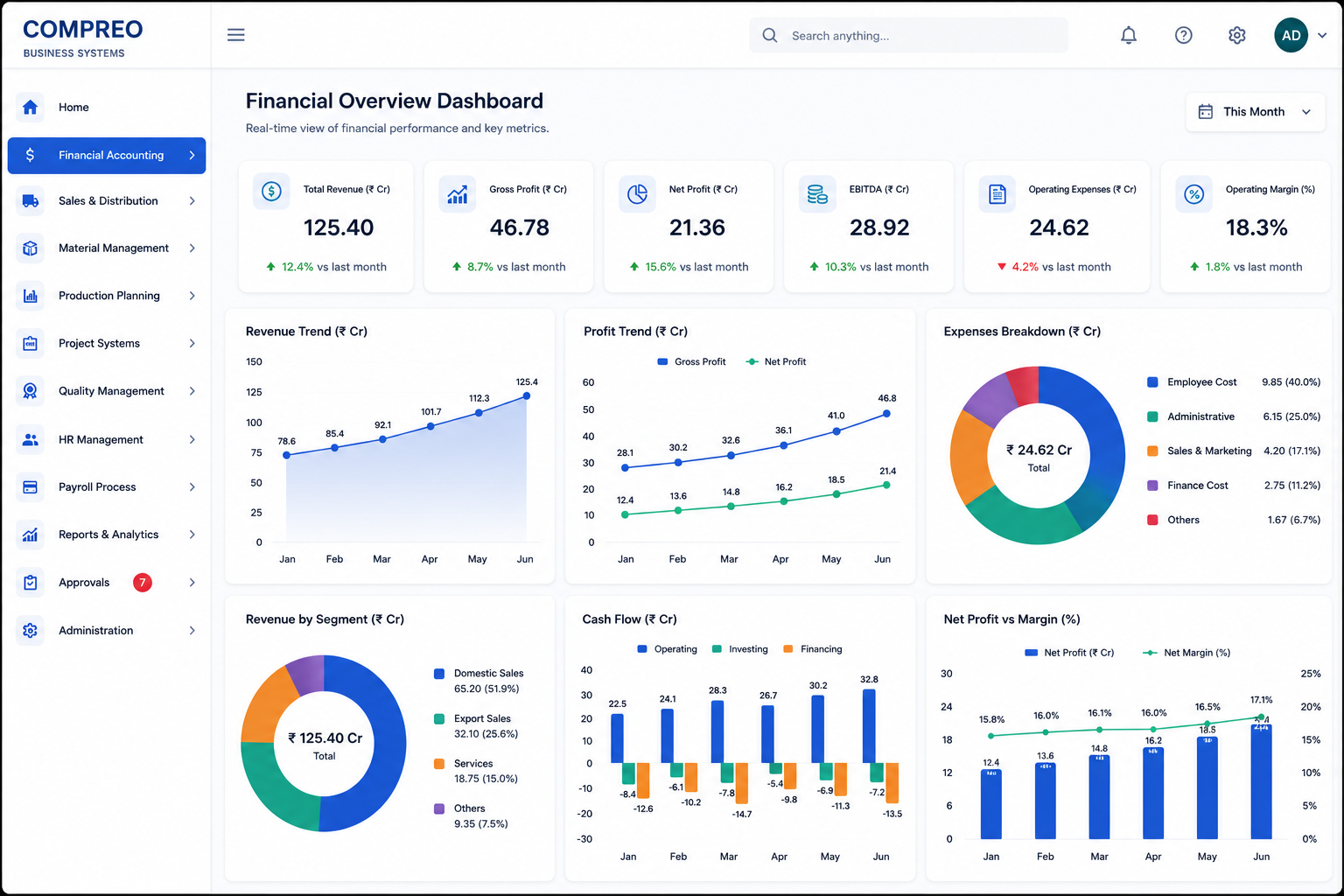
The single posting layer
under every process.
Finance teams spend their month reconciling what operations did against what the ledger says. The gap between the two — a GRN posted but not invoiced, a payment made but not cleared, a tax line booked to the wrong head — is where the close slips and the auditor's questions begin.
FI closes that gap by being the single posting layer underneath every process, not a ledger you reconcile to after the fact.
- General Ledger (GL) — chart of accounts, journals, cost centres, the single source of financial truth
- Accounts Payable (AP) — vendor invoices, 3-way-matched against PO and GRN, sitting on real terms
- Accounts Receivable (AR) — customer invoices, ageing, collections and credit control
- Banking — bank masters, payment runs, receipts and reconciliation against statements
- Taxation — GST/withholding computed at the line, posted to the right head, ready to file
- Financial close — period locks, accruals, sub-ledger-to-GL tie-out and statutory reporting
Six jobs the ledger does
without re-keying.
Every entry derives from the operational event that caused it, so the books stay current as the business runs.
Posts operations automatically
A GRN, an invoice, a payment, a customer collection — each creates its accounting entry the moment it happens, with no re-keying. The sub-ledgers and GL stay in lock-step.
Runs the 3-way match
AP holds the vendor invoice against the PO and GRN and matches on quantity, price and UOM. Clean matches post; exceptions route for review instead of stalling the whole batch.
Controls payables and receivables
Payment runs honour vendor terms; AR ageing and credit limits surface the customers who need chasing — before the cash gap shows up in the close.
Reconciles the bank
Statement lines clear against payments and receipts, so the bank balance the ledger reports is the balance the bank actually holds.
Computes tax at source
Tax is derived on the transaction line, not bolted on later, which keeps filing-ready numbers correct from the first posting.
Closes the period tied out
Period locks, accruals and sub-ledger-to-GL reconciliation make the financial close a controlled run, not a fire drill.
The flow every other
flow settles into.
FI is the module every flow eventually settles into. It is the financial back-stop of the entire platform — wherever value moves, FI records it.
Record-to-Report
FI is the engine of R2R: ledger, close and statutory reporting end to end.
Every other flow
Plan-to-Produce, Project-to-Cash, Acquire-to-Retire and the rest all post their financial impact through FI.
Modules it works alongside
What the books look like
when FI is the posting layer.
See Financial Accounting running on your data.
Bring the close that hurts most — the GRN/invoice gap, the bank reconciliation, the period-end tie-out — and we'll show you FI posting it as your operations run.