Sales & Distribution,
end to end.
Sales & Distribution (SD) is where a customer enquiry becomes a confirmed order, a dispatched truck, and a paid invoice. It governs pricing, availability, delivery and billing — and it is the engine that runs Order-to-Cash as one continuous flow rather than a handoff between the sales desk, the warehouse and finance.
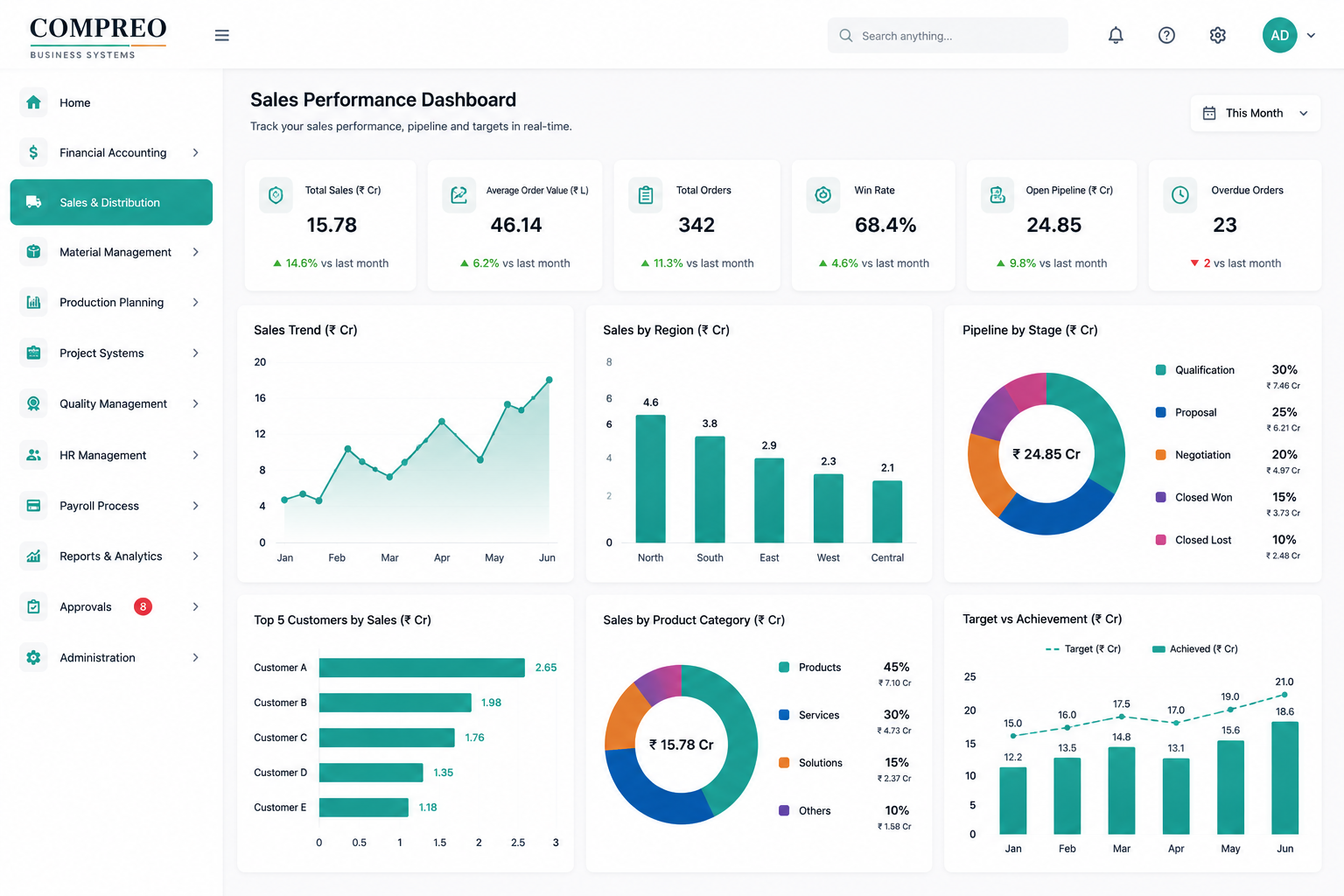
A single thread from
enquiry to invoice.
Most order desks lose time in the gap between the quote and the invoice: a price agreed on email, stock promised without checking it, a dispatch the billing team never sees. SD closes that gap.
It carries a single thread from inquiry through quotation, sales order, delivery and invoice, so what was committed to the customer is exactly what gets shipped and billed — on the same UOM, the same price, the same line item.
- Inquiry & quotation — capture demand, version quotes, convert the accepted one straight to an order
- Sales order — the binding commitment, with line-level material, quantity, UOM and dates
- Pricing — condition-based pricing with discounts, taxes and customer-specific rates
- ATP (available-to-promise) — promise dates against real stock and incoming supply
- Delivery & dispatch — picking, packing and goods issue tied back to the order
- Billing — invoice generated from the dispatch, posted to finance without re-keying
From the first quote to the
settled invoice.
Each step draws on the same order record — no re-entry, no drift between what was sold, shipped and billed.
Quote with one price book
Build quotations from condition-based pricing — base rate, customer discounts, freight and taxes — so every quote is consistent and auditable. The accepted quotation converts to a sales order without re-entry.
Promise dates you can keep
ATP checks the order against on-hand stock, open production and inbound receipts before a delivery date is committed. The customer hears a date the warehouse can actually meet.
Dispatch tied to the order
Picking, packing and goods issue draw straight from the sales order. The delivery records exactly what left the dock — no separate spreadsheet, no quantity drift between order and shipment.
Bill from the dispatch
The invoice is raised from the actual delivery, not a re-typed copy of the order, and posts to FI automatically. Order, dispatch and invoice reconcile line for line, on matching UOM.
Returns and credit memos
Handle rejections, short-supply and price corrections through credit and debit memos that reference the original order — so the customer ledger stays clean.
One customer view
Orders, deliveries, invoices and outstanding amounts sit against one customer record, shared with finance and the warehouse instead of scattered across inboxes.
What the order desk gets back.
Quote-to-order in one click
Accepted quotations convert without re-entry.
Fewer dispatch disputes
Order, delivery and invoice reconcile line for line.
Faster billing cycle
Invoices raised from dispatch, posted to finance same day.
One source of truth
Sales, warehouse and finance read the same order.
The spine of Order-to-Cash.
SD is the spine of one process and a participant in others. Business teams navigate by the flow; SD does the work underneath.
Order-to-Cash
From customer inquiry to dispatch to a settled invoice. SD owns the order and the billing; it collaborates with the modules that supply the goods and the money.
Module participants in Order-to-Cash
- SD — Sales & Distribution — inquiry, order, pricing, delivery, billing
- MM — Material Mgmt — stock and ATP behind the promise date
- PP — Production — make-to-order supply against the sales order
- QM — Quality — release checks before goods are issued
- FI — Finance — receivables, invoice posting and collection
See Order-to-Cash running on your data.
From the first inquiry to the settled invoice, on one thread. We will walk SD through a quote, an order and a dispatch using examples from your own business.