Production Planning,
end to end.
Production Planning (PP) turns a demand signal into a buildable plan and a finished good. It holds the BOM, the routing and the work-centres, runs MPS and MRP to size what you make and what you buy, and releases production orders the shop-floor can actually execute. One module from plan to part — not a planning spreadsheet bolted onto a stock ledger.
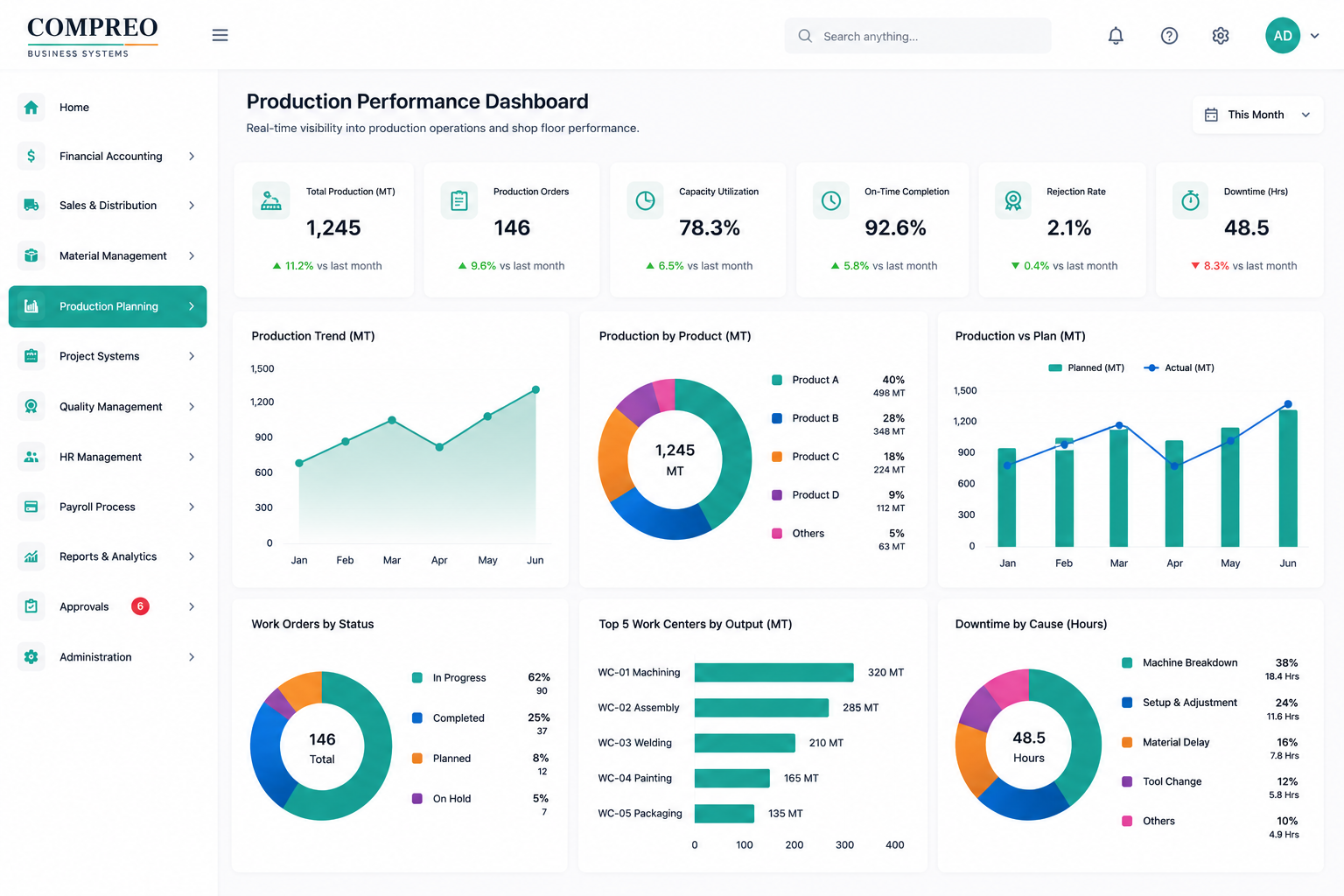
One record from BOM
to finished part.
Most plants run planning in three disconnected places — a BOM in engineering, a buy plan in purchase, and a build schedule on the shop-floor whiteboard. When any one of them moves, the other two go stale, and the gap shows up as a line stoppage or a part nobody ordered.
PP keeps the BOM, the routing, the plan and the order on one record, so a change to demand reaches the work-centre and the PR in the same pass.
- Bill of materials (BOM) — multi-level, with effectivity and scrap
- Routing — operations, work-centres and standard times
- Work-centres — capacity, shifts and costing rates
- MPS — the master schedule for finished goods
- MRP — net requirements for make and buy, by UOM
- Production orders — released, confirmed and back-flushed
Plan it, build it, cost it.
From the master schedule down to the confirmed operation — the work each plant does to turn a plan into a part.
Maintain the BOM and routing
Hold every assembly's structure and its sequence of operations in one place, version-controlled, so planning and costing read the same definition.
Plan with MPS
Set the master production schedule for finished goods against firm and forecast demand, and keep it the single agreed target for the plant.
Run MRP
Explode the BOM against the plan and on-hand stock to net out what to make and what to buy, raising planned production orders and purchase PRs in the right UOM.
Release production orders
Convert planned orders to firm, reserve components, and issue work to the work-centres with the routing attached.
Run the shop-floor
Confirm operations, record actual times and quantities, back-flush components and report scrap as work moves down the line.
Close with a GRN to stock
On completion the finished good is received into inventory via a GRN, ready for the next process to consume.
// Fewer expedite buys, fewer line stoppages, one schedule the plant trusts.
The engine of Plan-to-Produce.
PP is the engine of one process and a participant in others — planning is where demand, material and capacity meet.
Plan-to-Produce
PP holds the schedule, runs the netting, releases the order and confirms the build — the process runs on the PP record from demand to finished part.
PP raises the PR; MM turns it into an RFQ, a PO and a GRN. QM gates the build with in-process and final inspection, FI settles order cost against standard, and PM keeps the work-centres available.
Modules PP collaborates withSee Production Planning on your own BOM.
Bring one assembly's BOM and routing, and we'll plan it, build it and cost it on Compreo.