Quality control that gates material movement.
Quality Management (QM) governs whether material is fit to receive, fit to consume, and fit to ship. It carries inspection plans, incoming and in-process inspection, final QC, non-conformance handling and certificates — and it sits inline with the flows that move stock, so a failed lot never reaches the shop floor on a hidden spreadsheet.
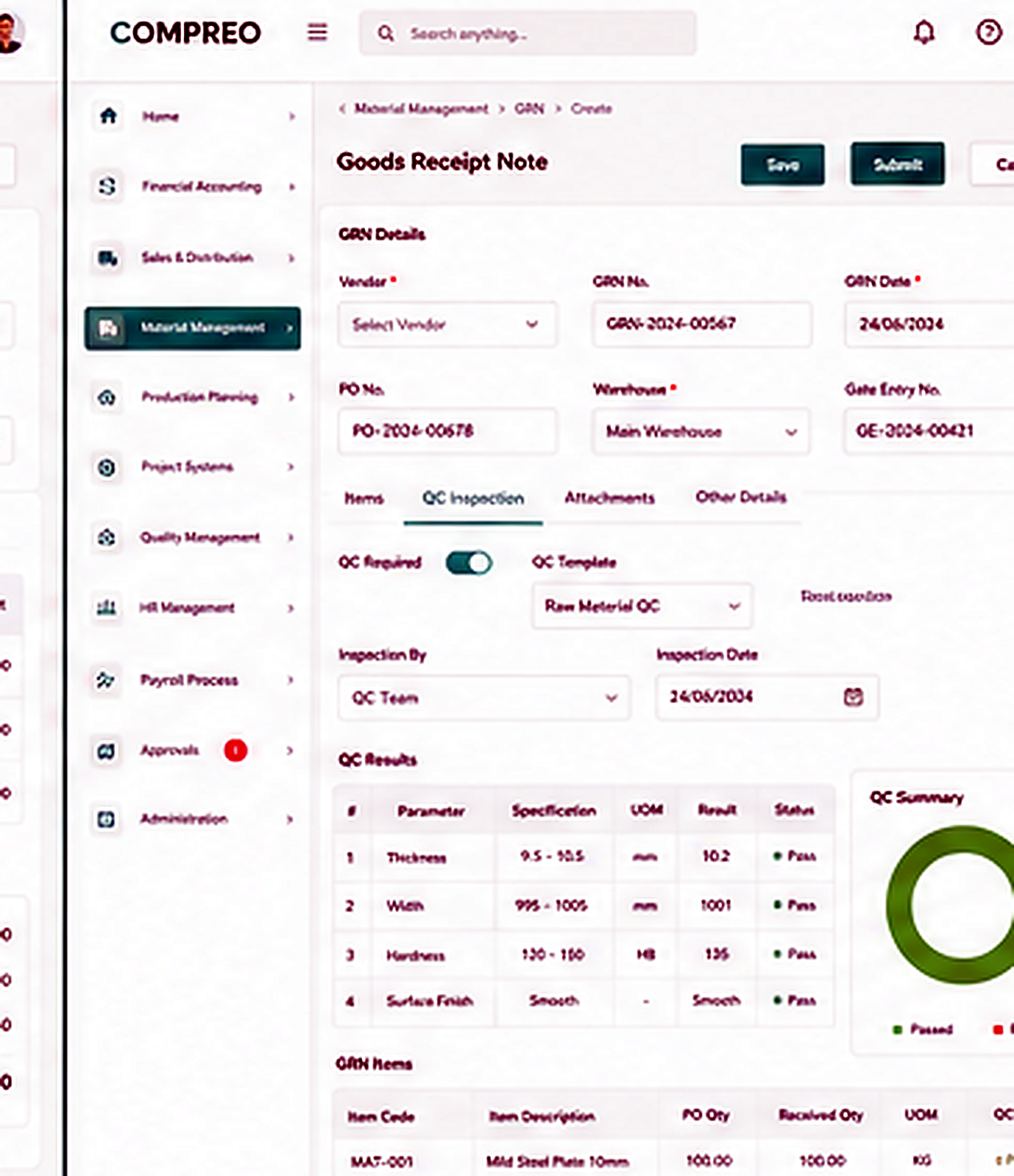
The rulebook and the record for inspection.
QM is the rulebook and the record for inspection across the plant. Each material that needs checking carries an inspection plan — the characteristics to measure, the sampling rule, and the UOM for each reading — so quality is defined once and applied consistently at every touchpoint.
When a GRN posts, a vendor declares a batch, or a production order completes, QM raises the inspection, holds the stock, and records the result against the lot.
- Inspection plans — characteristics, tolerances, sampling rules per material
- Incoming QC — inspection triggered on GRN, with accept / reject / rework dispositions
- In-process QC — checks at routing operations during production
- Final QC — release inspection before dispatch or stocking
- NCR — non-conformance records with disposition and cost owner
- CAPA — corrective and preventive actions linked back to the source NCR
- Certificates — Certificate of Analysis and inspection certificates held against the lot
Quality that holds, inspects and proves.
Inspection is inline with the flows that move stock — not a parallel record that nobody reconciles.
Hold stock until it passes
Material received against a PR-driven GRN lands in quality inspection, not free stock. Purchase sees the hold, stores cannot issue it, and finance does not clear the 3-way match until QC dispositions the lot — so an unchecked batch can never be consumed or paid for by accident.
Inspect in process, not just at the gate
Inspection points sit on the production routing, so an operation cannot be confirmed complete until its in-process checks pass. Defects are caught at the operation that created them, not three steps later at final QC.
Record non-conformance with an owner
A failed characteristic raises an NCR that names the disposition — rework, return to vendor, scrap, or use-as-is with concession — and the cost owner. The record stays attached to the lot, the vendor, and the source document for audit.
Close the loop with CAPA
Recurring NCRs drive a CAPA: a corrective action with a responsible owner and a verification step. Quality leaders see whether a fix actually held instead of re-raising the same defect every quarter.
Keep certificates with the lot
Vendor Certificates of Analysis and your own inspection certificates are stored against the batch and travel with it. When a customer or auditor asks for lineage on a shipped lot, it is one lookup — not a binder hunt.
What changes when quality gates the flow.
QM never runs alone.
It participates in every flow where material must be proven fit before it moves — receiving, producing, maintaining and delivering.
Procure-to-Pay
Incoming QC on the GRN gates receipt and the 3-way match.
Plan-to-Produce
In-process and final QC gate operations and finished-goods release.
Plan-to-Maintain
Inspection of spares and repaired equipment before return to service.
Project-to-Cash
Material and milestone QC against BOQ / WBS before billing.
Module participants
See QM gating material on your own data.
Bring a real receipt or production order and we'll show you the inspection raising, the stock holding, and the disposition closing the loop — with your characteristics and your tolerances.