One flow from requisition to payment.
Procure-to-Pay is the spine that connects the people who need materials to the vendors who supply them and the finance team that pays for them. It runs across purchase, stores, quality and finance, and reaches outside the company to every vendor on the vendor portal. Most ERPs run it as a chain of disconnected steps — a PR in one system, a quotation comparison in a spreadsheet, a GRN that finance never sees until the invoice is disputed. Compreo runs it as one connected flow, where every stage carries the document, the quantity and the approval forward to the next.
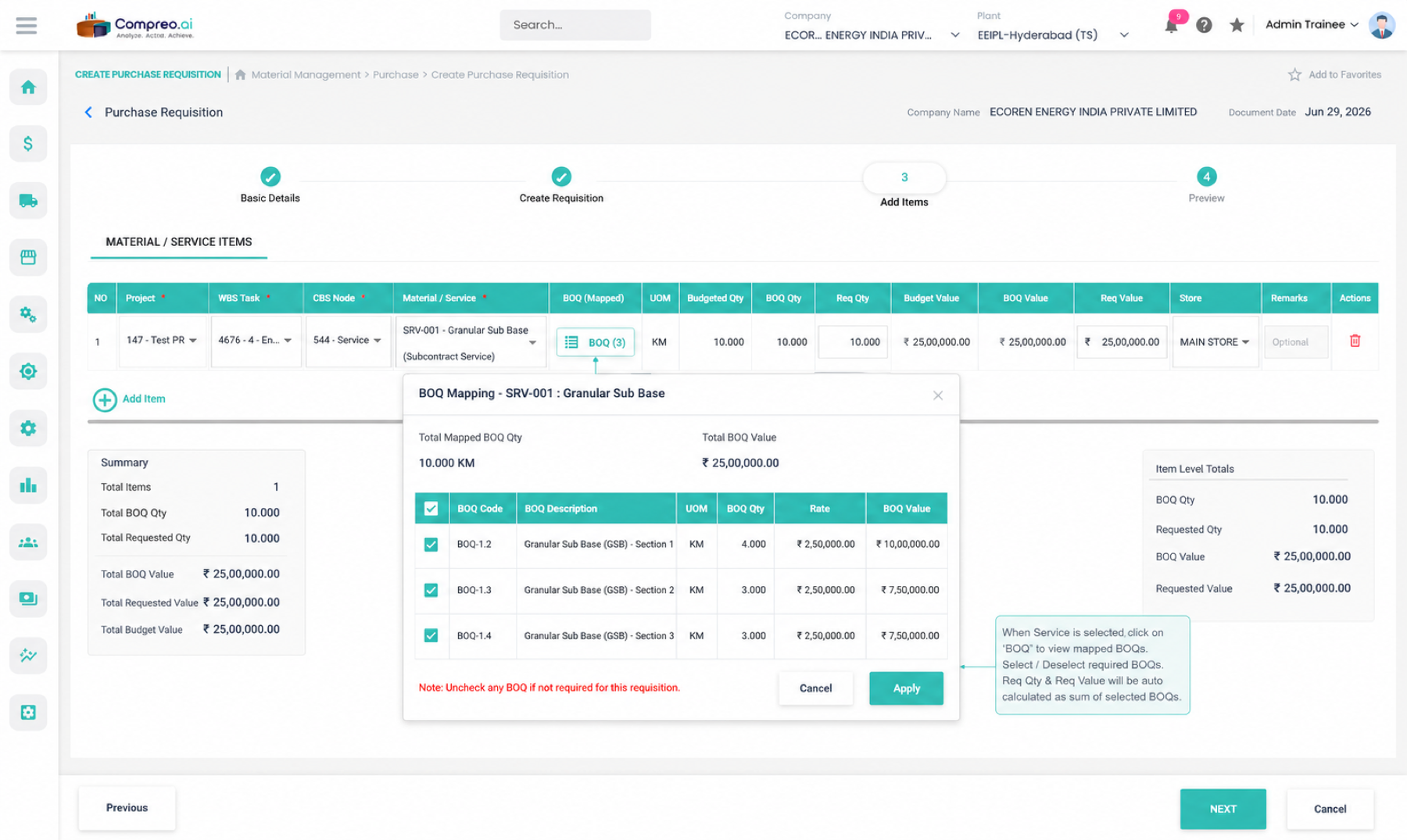
The stages, end to end.
Procure-to-Pay moves a single demand through nine stages without a re-key in between. Each stage hands the buyer, the unit of measure and the running approval state to the one after it, so nothing is reconstructed and nothing is lost.
Requisition (PR)
Stores or a department raises a need; the demand is captured against a cost centre or WBS, not a phone call.
RFQ
Purchase floats the requirement to a shortlist of vendors and collects sealed quotes in one place.
Quotation Analysis
Quotes are compared on landed cost, lead time and terms on a single comparative, not across email threads.
Purchase Order (PO)
The chosen quote becomes a PO with agreed price, UOM and delivery schedule, fully traceable to the PR that started it.
Vendor Acknowledgment
The vendor confirms the PO on the portal, accepting quantity, price and dates — or proposes changes before despatch.
GRN
Stores receives against the PO, recording actual quantity and the UOM the goods arrived in.
Quality
Inspection clears, rejects or accepts-with-deviation; only passed quantity is available to consume or pay for.
Invoice Match (3-way)
The invoice is matched against the PO and the GRN automatically; price and quantity variances are flagged before posting.
Payment
A clean, matched invoice flows to FI for scheduling and release, with the full trail behind it.
Where Procure-to-Pay usually breaks.
The stages look simple on a diagram. In practice the cost is in the seams between them — the manual comparison, the blind vendor, the mismatch that nobody catches until finance refuses to pay.
Manual quotation comparison
Quotes arrive by email and get pasted into a spreadsheet that one buyer owns. Landed cost is calculated by hand, terms get missed, and the audit trail for "why this vendor" lives in someone's inbox.
Vendors cannot see PO status
Once a PO is issued, the vendor calls to ask if it was approved, when to deliver, and whether the last invoice was received. Purchase becomes a switchboard instead of a buying function.
GRN and invoice mismatch on UOM
The PO says 100 boxes, the GRN records 1,000 pieces, the invoice bills per kilogram. Without a single UOM carried through every stage, the 3-way match fails and the payment stalls in a queue of exceptions.
Approval chains break on leave
An approver travels and the PR or PO sits untouched for a week. With no delegation path, urgent procurement waits on one person's calendar.
How Compreo runs it as one flow.
Each friction maps to a built-in answer. The document, the quantity and the approval state move with the demand, so the work happens once.
One comparative, not a spreadsheet
Quotes captured against an RFQ are scored on a single comparative for price, lead time and terms; the award decision and its reasoning are recorded on the document itself.
A live window for every vendor
On the vendor portal, suppliers see PO status, acknowledge orders, view receipts and track invoice progress — without a call to purchase.
UOM carried through every stage
A single unit of measure flows from PR to PO to GRN to invoice, with defined conversions, so the 3-way match reconciles on quantity and price by rule rather than by argument.
Approvals that find a path
Approval chains support delegation and substitute approvers, so leave or travel reroutes the PR or PO instead of stopping it.
Quality gates before payment
Inspection results sit between GRN and invoice, so only passed quantity becomes payable and rejects never reach FI.
How the flow shapes itself per industry.
The nine stages stay the same; what changes is where each one anchors. Compreo carries the same spine into each vertical's working pattern.
Requisitions are driven by BOM explosion and reorder points; GRN triggers incoming QM inspection before stock is available to the shop floor, so unverified material never enters production.
Procurement ties to the site and the BOQ; GRN happens at site, often captured on mobile, and is reconciled against budgeted quantities per item rather than against a central warehouse.
Every PR and PO is tagged to a WBS element and project; quotation analysis weighs delivery against milestone dates, and committed cost rolls up to project control as the PO is raised.
Stores procurement for kitchen and F&B runs on par levels and short lead times; GRN and quality checks on perishables happen at the dock, with quick reconciliation against daily consumption.
The modules behind the flow.
Procure-to-Pay is not owned by one module — it is a collaboration. Materials management runs the buying and receiving, quality clears the goods, finance matches and pays, and the portal brings the vendor into the same flow.
What the connected flow delivers.
See Procure-to-Pay running on your data.
Bring a real requisition, a live vendor list and one disputed invoice. We will walk the full flow — PR to payment — on Compreo and show you where the seams disappear.