From every transaction to financial close
Record-to-Report is the discipline of turning every operational transaction into a closed, reportable set of accounts. It runs across finance, controlling and treasury — the teams who answer for the numbers when the board asks. Most ERPs run it in fragments: sub-ledgers in one place, the general ledger in another, and the close itself stitched together in spreadsheets. Compreo runs it as one flow, where every posting traces back to the document that created it and forward to the statement that reports it.
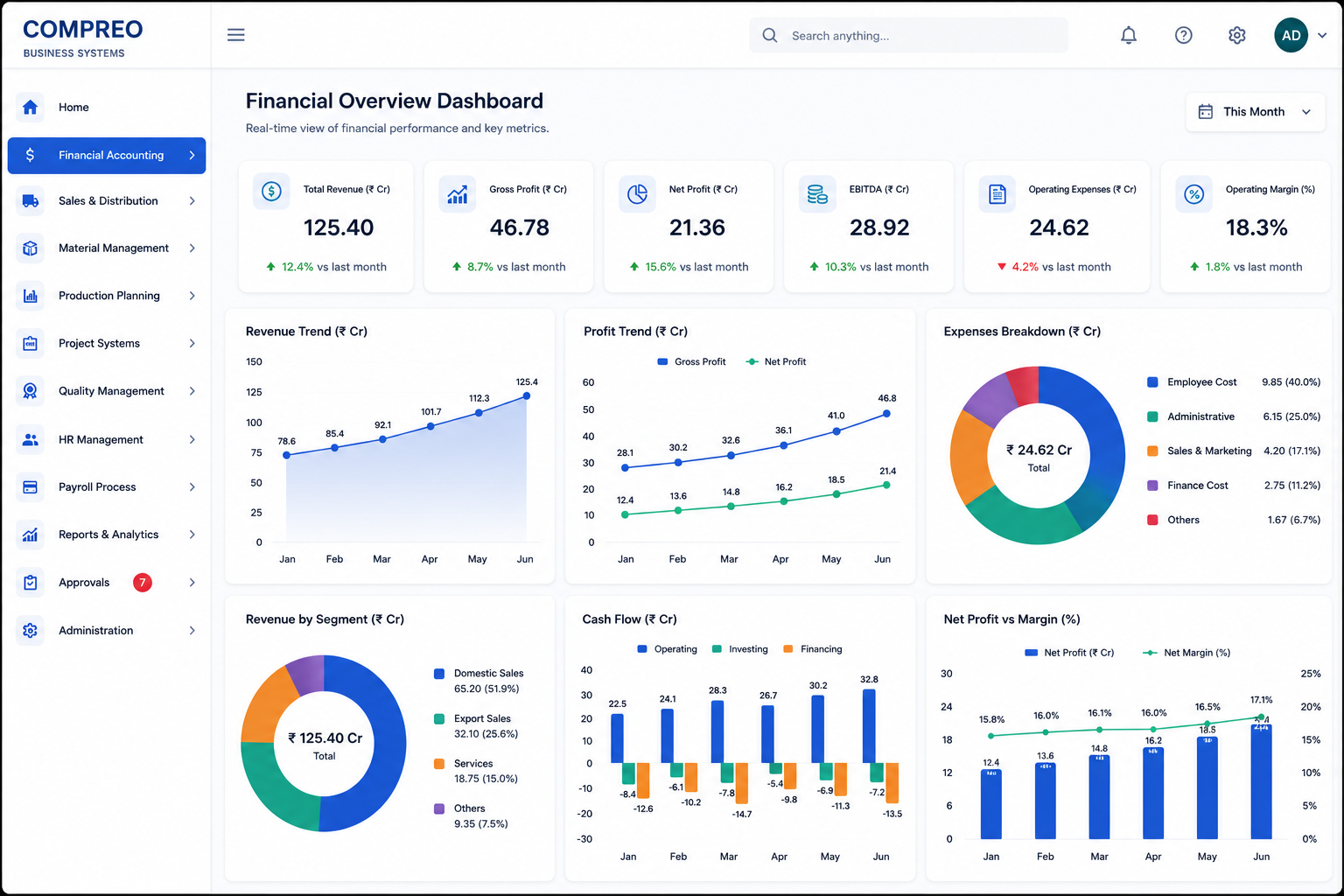
The stages, end to end
Record-to-Report begins where operations end — a GRN posted, an invoice matched, an asset capitalised — and does not finish until consolidated statements are signed. Each stage feeds the next on the same ledger, so nothing has to be re-keyed or re-reconciled downstream.
Transactions
Goods receipts, invoices, payments and asset events post as they happen, carrying their source document.
Sub-ledgers
Payables, receivables, fixed assets and stock track the detail behind each control account.
General Ledger
Every sub-ledger posting lands in the GL in real time, tagged to cost centre, project and entity.
Reconciliation
Sub-ledger balances are matched to GL control accounts continuously, not at month-end.
Accruals & provisions
Period-end adjustments, accruals and provisions are raised against open commitments and unbilled receipts.
Period close
A guided checklist locks sub-ledgers, runs valuations and closes the period in order.
Consolidation
Multi-entity and multi-tenant books roll up with eliminations and currency translation applied.
Reporting
Trial balance, P&L, balance sheet and project reports draw from the closed ledger directly.
What's hard about this process
The close is not difficult because the accounting is hard. It is difficult because the data lives in too many places, and reconciling those places by hand consumes the days the close is supposed to take.
Sub-ledger and GL disagree
The payables sub-ledger says one thing, the GL control account says another, and someone spends the close hunting the difference. When the bridge between detail and summary is manual, the two drift apart every period.
Reconciliation is manual
Bank, intercompany and control-account reconciliations live in spreadsheets keyed off exported reports. By the time they balance, the numbers underneath have already moved.
The close is slow
Sub-ledgers close in the wrong order, accruals are raised late, and the finance team waits on operations to confirm what was received but not yet invoiced. A close that should take days takes weeks.
Consolidation lives in spreadsheets
Each entity sends a trial balance, finance pastes them into a master workbook, and eliminations and currency translation are done by formula. The group result is only as reliable as the last copy-paste.
How Compreo handles it
Compreo holds the sub-ledgers and the GL in one system, so the reconciliation most teams fight for is structural rather than manual. Each stage maps to a concrete platform behaviour.
See how the platform is built →- Posting carries its source — Every sub-ledger entry posts to the GL with the originating document, cost centre, project and WBS attached, so any balance drills straight back to its transaction.
- Continuous reconciliation — Sub-ledger-to-control-account matching runs as postings happen; the period opens already reconciled instead of starting from a variance.
- Accruals against live commitments — Provisions and accruals draw on open POs, unbilled GRNs and pending invoices, so period-end adjustments reflect what operations actually owes and is owed.
- Guided period close — A close checklist sequences sub-ledger locks, valuations and adjustments, showing what is done, blocked or outstanding before the GL is closed.
- Built-in consolidation — Multi-entity and multi-tenant books consolidate inside the platform, with intercompany eliminations and currency translation applied to the same ledger that produced them.
- Reporting from the closed ledger — Trial balance, P&L, balance sheet and project statements read the live GL directly, so the report and the books can never disagree.
How the close differs by structure
The shape of Record-to-Report changes with how an organisation is structured for reporting. Compreo carries the same ledger through each of these without a separate consolidation tool.
Group, subsidiary and joint-venture books each close on their own calendar, then roll up with intercompany eliminations and currency translation handled in-platform. Finance sees the entity result and the consolidated group view from one source, not from a master spreadsheet posted after the fact.
Project-driven businesses need the same closed ledger reported two ways — by cost centre for the organisation and by project or WBS for delivery. Because every posting is tagged with both dimensions at source, the project P&L and the departmental P&L reconcile to the same trial balance with no separate allocation run.
Which modules participate
Record-to-Report is owned by finance, but it is fed by every operational module that posts value. These modules collaborate on one ledger.
The general ledger, accounts payable and receivable, and the period close itself.
Capitalisation, depreciation and disposal, posting to the asset sub-ledger and the GL.
Stock valuation and the GRN-to-invoice postings behind the inventory and payables sub-ledgers.
Billing and revenue postings that feed the receivables sub-ledger.
The project and WBS dimensions that drive project-level reporting and accruals.
One ledger, no month-end task
All sub-ledgers — payables, receivables, fixed assets and stock — reconcile to FI control accounts as a property of the platform, not as a month-end task.
What changes when the close runs on one ledger
See Record-to-Report running on your data
Bring a recent close, and we will show you how the same transactions move from sub-ledger to consolidated statement on one ledger — with the reconciliation already done.